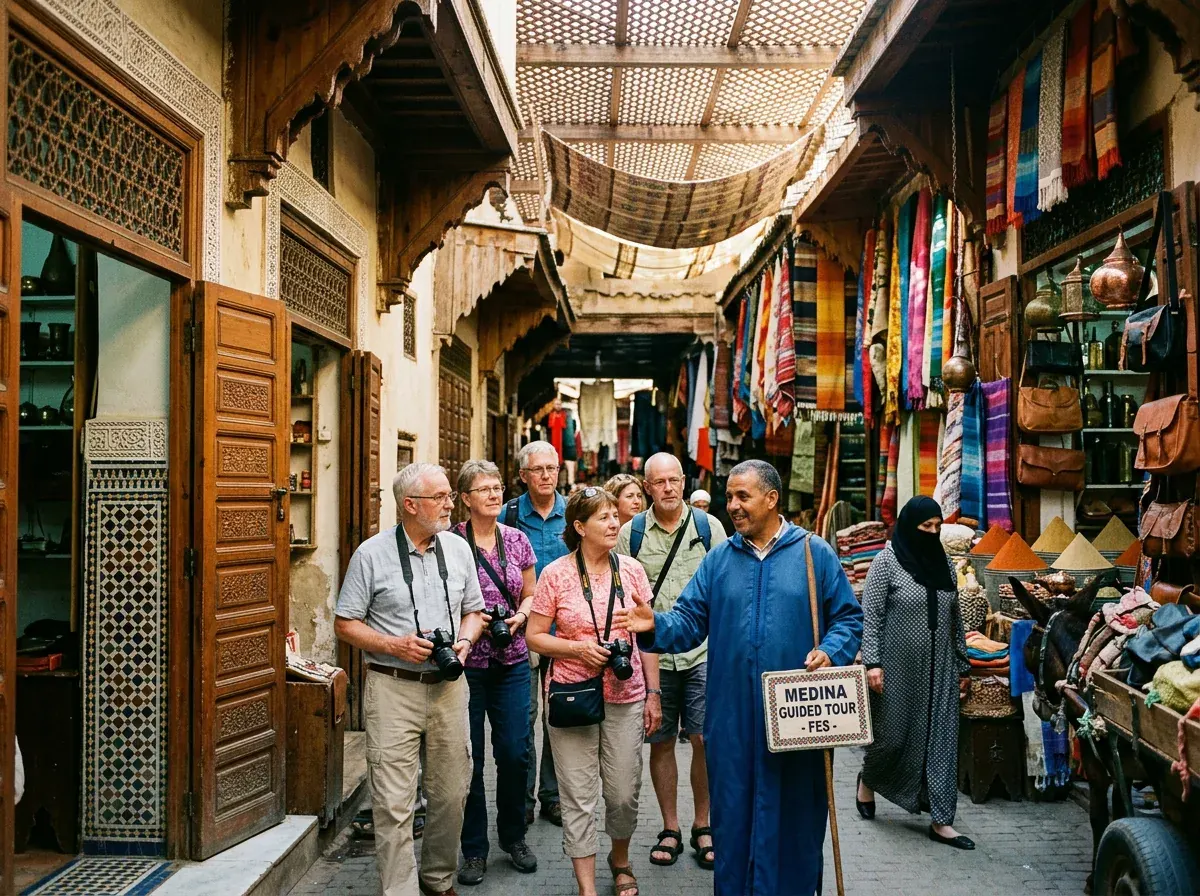
Agadir and the Souss run on Darija (Moroccan Arabic) and Tashelhit Berber in daily life, with French on menus and signage. A handful of phrases — and a word or two of Berber, which delights people in the south — opens doors that money alone cannot.
In this guide
Greetings and basics
Greetings matter enormously in Morocco, and Agadir is no exception. Opening an interaction with the right words signals respect and almost always produces a warmer response. Darija greetings are similar to Modern Standard Arabic but with a distinctly Moroccan accent — the 'q' often becomes a glottal stop, and vowels are compressed. In the Souss, a Berber 'azul' (hello) raises an instant smile. Don't worry about perfection; the attempt is what counts.
- Salam / Salam alaykum — Hello / Peace be upon you (standard greeting)
- Azul — Hello in Tashelhit Berber (warmly received across the Souss)
- Wa alaykum salam — And upon you peace (response)
- Labas? / Labas, hamdullah — How are you? / Fine, praise God
- Shukran — Thank you
- La shukran — No, thank you (essential for polite refusals)
- Smah liya — Excuse me / I'm sorry
- Bslama — Goodbye
- Wakha — OK / Alright
Numbers and money
Numbers in Moroccan Arabic (Darija) follow a familiar pattern from Modern Standard Arabic. For market haggling and taxi fares, these are the most useful:
- Wahed, jouj, tlata, rba, khamsa — 1, 2, 3, 4, 5
- Stta, sba, tmanya, tsa'oud, a'shra — 6, 7, 8, 9, 10
- A'shr-in, tlat-in — 20, 30 (and so on by tens)
- Miya — 100 | Alf — 1,000
- Bshhal? — How much?
- Ghali bzzaf — Too expensive
- Khfef shwiya — A little cheaper
- Mashi mushkil — No problem
French essentials
French is the language of menus, hotels, road signs and business in Morocco — a legacy of the French Protectorate (1912–1956) that remains deeply embedded. Along the Agadir corniche and in the resorts you'll also hear plenty of English, German and Dutch, but a little French still opens far more, especially with taxi drivers and in the inland Souss towns.
- Bonjour / Bonsoir — Good day / Good evening
- S'il vous plaît / Merci — Please / Thank you
- L'addition, s'il vous plaît — The bill, please
- Où est...? — Where is...?
- Je voudrais... — I would like...
- Combien ça coûte? — How much does it cost?
- C'est trop cher — It's too expensive
- Parlez-vous anglais? — Do you speak English?
Pronunciation notes and haggling
Darija compresses vowels significantly compared with Modern Standard Arabic — 'drari' (children) sounds almost like a single syllable. The letters 'gh' (غ) and 'kh' (خ) are guttural sounds not in English: 'gh' resembles a soft French 'r'; 'kh' resembles the 'ch' in 'loch'. Neither is difficult with a little practice.
For haggling at Souk El Had, the ritual is friendly and expected. Open in French or Darija, ask 'bshhal?' (how much?), respond to the price with a wince and 'ghali bzzaf' (too expensive), offer roughly 40–60% of the opening price, and negotiate from there. A smile and good humour throughout make the exchange enjoyable for both sides — and in Agadir's huge market, where stalls compete fiercely, walking away slowly often produces the final best price.
Frequently asked
Do people in Agadir speak English?
In the resort hotels, on the corniche and with guides — yes, often quite well, and you'll hear German and Dutch too given the package-holiday crowd. At Souk El Had and in the inland Souss, French and Darija dominate, with Tashelhit Berber the mother tongue of many. A few phrases in any of them go a very long way.
What language is spoken in Morocco?
Morocco's official languages are Classical Arabic and Amazigh (Tamazight). Darija (Moroccan Arabic) is the everyday spoken tongue for most Moroccans. French is widely used in business, education and signage. Spanish is spoken in the north (Tangier, Tétouan, Nador). In practice, French and Darija cover most travel situations.
Is Moroccan Arabic the same as Egyptian or Lebanese Arabic?
Darija is a distinct dialect with significant Amazigh, French and Spanish influences. It is notably different from Egyptian, Levantine or Gulf dialects — speakers of those dialects often find Darija difficult to understand. Modern Standard Arabic (the written, formal register) is understood but not spoken conversationally.
How do you say 'thank you' in Moroccan Arabic?
'Shukran' (شكراً) — borrowed directly from Modern Standard Arabic and universally understood. The purely Darija equivalent is 'baraka llahu fik' (God bless you), which you'll hear in response to a compliment or act of generosity.
Do I need French to travel around Agadir?
Not strictly — the resorts and corniche run well in English. But French opens far more of the south: menus at local restaurants, taxi negotiations, directions in the Souss towns and everything off the tourist strip. Even a few phrases make a disproportionate difference.
Planning a trip?
Let our team handle the details.
Tell us your dates and style and we'll send a written itinerary and a transparent quote within 24 hours.
Request an itineraryKeep reading
Culture
Morocco Etiquette & Customs
Agadir's resort culture is relaxed, but a little awareness still goes a long way. Beachwear belongs on the seafront; cover up for Souk El Had and inland villages, greet warmly, ask before photographing people, use your right hand, and embrace the unhurried pace of mint tea.
Culture
Moroccan Food & Drink
Agadir eats from the sea. As Morocco's largest fishing port the city serves some of the country's freshest seafood, alongside the southern Souss specialities built around argan oil — and the same sweet mint tea poured everywhere along the coast.
Practical
Getting Around Morocco
Agadir has no train station, so getting around the south coast means taxis, buses and private cars. Within the resort it's easy on foot or by petit taxi; for Taghazout, Paradise Valley, the Souss and longer hops to Marrakech or Essaouira, you'll want a bus or a private driver.